
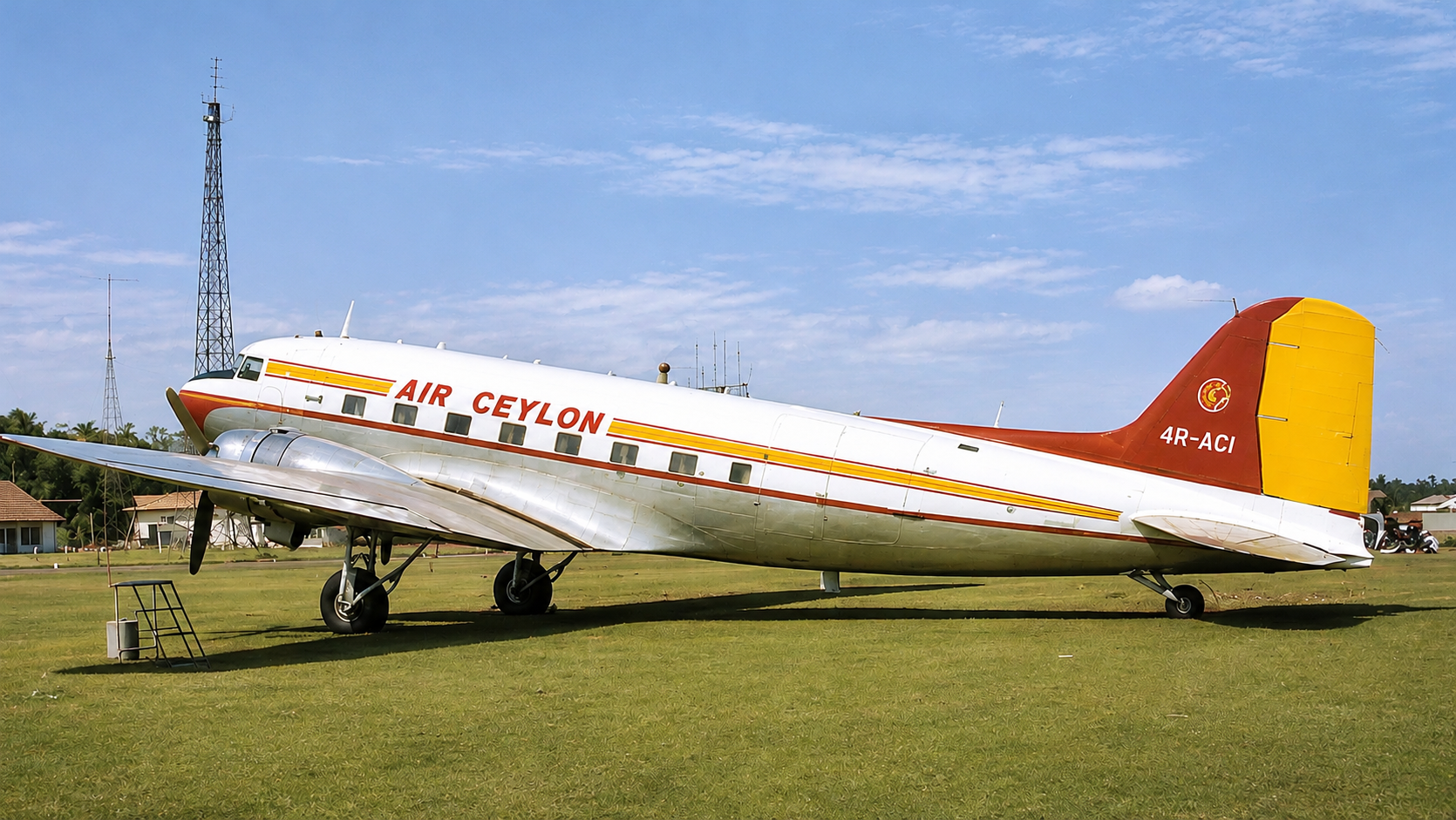
Air Ceylon was Sri Lanka’s first national airline and played an important role in the development of commercial aviation on the island. Established in 1947, when the country was still known as Ceylon, the airline connected Colombo with regional and international destinations during an important period.
From its early Douglas DC-3 aircraft to international services reaching London, the airline helped establish the foundations of modern air travel.
When Was Air Ceylon Established?
Air Ceylon began operations in 1947 under the Ministry of Communications and Works.
Earlier that year, air services had started under the name Ceylon Airways using three Douglas DC-3 aircraft. The airline subsequently adopted the Air Ceylon name.
Its establishment came shortly before Ceylon gained independence from British rule in February 1948.
What Was the First Air Ceylon Flight?
The airline’s inaugural international commercial flight took place on 10 December 1947.
A Douglas DC-3 aircraft named Sita Devi departed from Ratmalana Airport near Colombo and travelled to Madras, now Chennai, via Palaly in northern Sri Lanka.
Captain Peter Fernando operated the historic flight, which carried 16 passengers.
What Aircraft Did Air Ceylon Use?
The airline began with Douglas DC-3 aircraft, commonly known as Dakotas.
These twin-engine propeller aircraft were widely used around the world during the 1940s and became important to the development of commercial passenger transport.
Compared with modern aircraft, the DC-3 had a smaller passenger capacity, a slower cruising speed and more limited onboard facilities.
Which International Destinations Did Air Ceylon Serve?
The airline initially focused on connecting Colombo with destinations in India.
Its first international route linked Ratmalana, Palaly and Madras.
By 1949, services to London had also begun, marking an important expansion beyond regional aviation.
Travellers interested in how modern routes differ can explore Flying to Sri Lanka via Singapore: What Should You Know?.
Why Was Ratmalana Airport Important?
Ratmalana Airport played a central role in the airline’s early operations.
Officially opened in February 1938, Ratmalana was Sri Lanka’s main civil aviation gateway before international operations gradually shifted towards Katunayake.
Katunayake subsequently developed into the country’s principal international airport, now known as Bandaranaike International Airport.
Did Air Ceylon Work with International Airlines?
Yes. International partnerships played an important role in the airline’s development.
In 1951, Air Ceylon was incorporated with government ownership of 51%, while Australian National Airways held the remaining 49%.
A partnership with KLM Royal Dutch Airlines began in the 1950s, helping support the airline’s international operations.
What Happened to Air Ceylon?
Air Ceylon operated for more than three decades before its closure in 1978.
A new national carrier, Air Lanka, was established in January 1979 and began operating later that year.
Air Lanka subsequently developed into SriLankan Airlines, the country’s modern national carrier.
How Has Flying to Sri Lanka Changed Since 1947?
Today, Bandaranaike International Airport connects Sri Lanka with destinations across Asia, the Middle East, Europe and other regions through nonstop and connecting services.
Travellers comparing modern journey options can read Direct Flights to Sri Lanka vs Connecting Flights: Which Is Better?.
Those planning a holiday can also explore Sri Lanka Holiday Planning: How to Build Your Trip Around Flight Times for practical travel advice.
Why Is Air Ceylon Important to Sri Lankan Aviation History?
Air Ceylon helped establish scheduled passenger aviation during a period when international air travel was still developing.
Its early routes connected Sri Lanka with neighbouring countries, while later international services expanded the country’s aviation links.
Conclusion
Air Ceylon holds an important place in Sri Lanka’s aviation history as the country’s first national airline.
Although Air Ceylon was eventually succeeded by Air Lanka, its pioneering role remains an important chapter in the story of flying to Sri Lanka.